
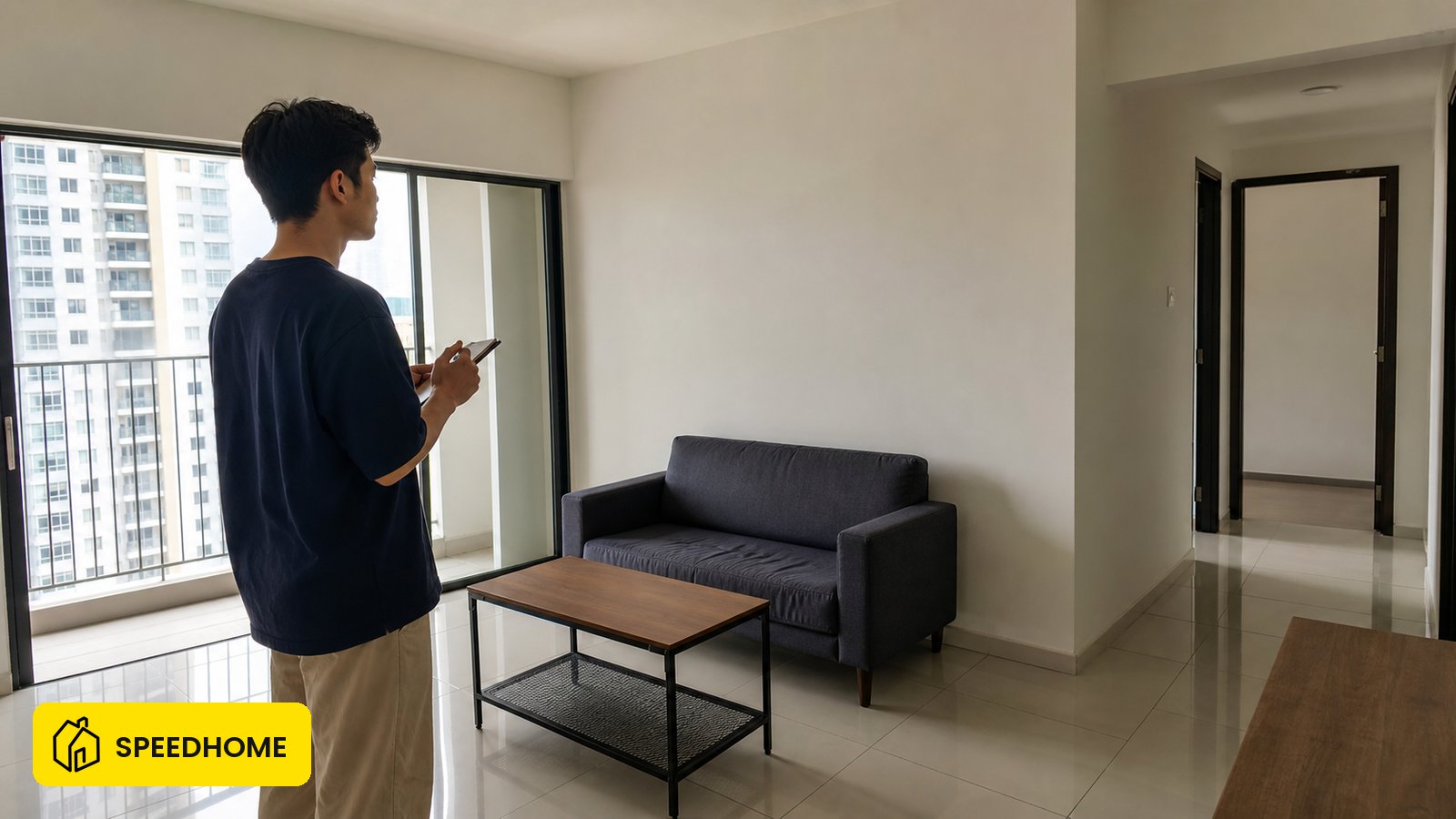
From-scratch furnishing for a 2-bedroom apartment runs RM8,000 to RM25,000, but platform data (2026) shows roughly 7 in 10 partially furnished Klang Valley listings provide only aircond, water heater, kitchen cabinet and wardrobe — so the real tenant-buying bill runs RM10,000–RM18,000. Confirm the landlord's inventory at viewing; "fully furnished" is not a standardised checklist in Malaysia.
How much does it cost to furnish a 2-bedroom apartment in Malaysia?
Furnishing a 2-bedroom apartment in Malaysia from scratch costs roughly RM8,000 to RM25,000 depending on the tier of furniture and whether appliances are included. Budget-tier setups sit at the lower end, mid-range durable sets occupy the middle, and premium or imported pieces push cost above the upper band. Malaysia's zero-deposit rental platform maintains this guide.
Platform operator data (2026) shows roughly 7 in 10 partially furnished 2-bedroom listings in the Klang Valley provide only aircond, water heater, kitchen cabinet and wardrobe — so the real tenant-buying bill runs RM10,000–RM18,000, not the RM25,000 full-build figure. "Fully furnished" is not a standardised checklist in Malaysia, so inspect, don't assume. Most Malaysian rentals come with at least some items already: confirm the landlord's inventory list at viewing, since a partially furnished unit that already includes airconds, water heater, kitchen cabinets and a wardrobe saves a meaningful share of the outfitting cost. Fridge, washing machine, beds and sofa are almost always on the tenant.
What does a room-by-room furnishing budget look like?
Breaking the 2-bedroom apartment into rooms helps identify where the cost goes and where you can delay spending without affecting daily life. The merged table below combines typical landlord provision with what you usually buy — subtract the landlord's items from the upper bound to get your real spend.
The ranges below are mid-tier, new-item market figures (local furniture chains, IKEA-equivalent mid-range, online marketplaces). Reduce them by 30–50% if you go second-hand or local brands; raise them for premium or imported pieces.
| Room / category | Key items | Landlord usually provides | Tenant typically buys | Tenant budget if buying new (mid-tier) |
|---|---|---|---|---|
| Master bedroom | Bed frame, mattress, wardrobe, side tables | Sometimes a built-in wardrobe | Bed, mattress, side tables | RM2,500 – RM6,000 (mattress alone RM800–RM2,500) |
| Second bedroom | Bed frame, mattress, wardrobe or storage | Often empty | Bed, mattress, storage | RM1,800 – RM4,500 (single bed lowers cost) |
| Living area | Sofa, coffee table, TV console, curtains | Curtains or blinds sometimes | Sofa, coffee table, TV console | RM1,500 – RM5,000 (sofa is the largest line item) |
| Dining area | Dining table and chairs | Almost never | Full dining set | RM600 – RM2,000 (4-seater is most common) |
| Kitchen appliances | Fridge, washing machine, microwave, utensils | Varies — confirm | Fridge, washing machine, microwave if not provided | RM2,000 – RM6,000 |
| Lighting and fans | Ceiling fans, pendant lights, standing lamps | Often built-in ceiling fans | Portable fans, lamps | RM400 – RM1,500 |
| Window treatment | Curtains, blinds, tracks | Sometimes provided | Curtains, tracks | RM300 – RM1,200 |
| Small items | Hooks, mats, storage boxes, kitchen rack | Not provided | All of it | RM200 – RM600 |
A budget setup on local brands or Shopee/Lazada furniture with second-hand appliances can come in around RM8,000–RM12,000. A mid-range setup with durable branded pieces lands RM15,000–RM22,000; premium or imported pieces exceed RM30,000.
What do tenants most often under-budget for?
The four most common under-budget items are curtains, lighting, mattress delivery, and small kitchen appliances — together they add RM1,500–RM3,500 that almost no first-time tenant remembers to include. Curtains and tracks for a full 2-bedroom run RM300–RM1,200 but every window needs measuring, and made-to-fit panels add another 20–30% over off-the-shelf. Pendant lights and standing lamps look cheap at RM40 each until you multiply by every room; the realistic lighting bill is RM400–RM1,500. A decent queen mattress alone is RM800–RM2,500 and delivery plus old-mattress disposal runs another RM150–RM400. Small appliances — rice cooker, kettle, iron, vacuum, mop, air fryer — quietly add RM600–RM1,500. The fix is to add a flat RM1,000 buffer to whatever the room-by-room table totals and treat it as the "stuff you forgot" line.
How does unit size and floor plan shift the furnishing cost?
A 650 sqft studio or compact 2-bedroom can be RM3,000–RM6,000 cheaper to furnish than a 900+ sqft family-sized 2-bedroom with the same room count, because smaller floor plans need smaller furniture and a built-in wardrobe removes the most expensive single line item. Three floor-plan factors matter most: built-in wardrobe presence (saves RM1,500–RM3,000 in the master bedroom), wet/dry kitchen separation (a separate dry kitchen needs an extra fridge or freezer plus extra cabinetry, adding RM800–RM2,000), and balcony or yard space (an extra outdoor chair set plus plant pots runs RM300–RM1,200). Condo versus landed shifts the calculus too: landed units often include a water heater and a yard tap that condo units charge extra for, but landed units usually have no built-in kitchen cabinet, so the tenant eats that RM2,000–RM4,000 line.
When should you start buying furniture relative to the handover date?
Start 4–6 weeks before handover, not the week before, because sofa and mattress lead times in Malaysia run 2–4 weeks and made-to-fit curtains another 1–2 weeks on top. Sofa fabric and custom sizes from local furniture makers usually need 14–21 working days; branded mattresses from major stores are faster (3–7 days) but premium pocket-spring models stretch to 2 weeks. The realistic buying sequence: book the sofa and bed frame 4–6 weeks out, order the mattress 2–3 weeks out, schedule curtains for measurement 1–2 weeks before keys, and leave small items (lamps, hooks, kitchen rack) for the first week in. If your handover is during a sale window (11.11, 12.12, year-end clearance, pre-CNY), shift everything earlier — popular SKUs sell out within days of the campaign opening.
Where do Malaysians actually buy affordable furniture?
Most tenants split the bill across four routes: IKEA Damansara or IKEA Batu Kawan for new mid-range staples, local furniture malls like Furniture Mall PJ or Jakel for bulk pieces, Facebook Marketplace and Carousell for second-hand sofas and fridges, and Shopee/Lazada for small items and lighting. Timing matters as much as the channel — year-end clearance, 11.11, 12.12, Hari Raya and the weeks before Chinese New Year are the sale windows where mid-range branded sets drop 15–30%. Going second-hand on the two highest-value lines (sofa and fridge) typically saves RM2,000–RM4,000 on a 2-bedroom outfit if you can collect yourself.
Cross-check the furnishing labels on the furnished vs unfurnished rental guide, then strip the table down to the items your landlord's inventory confirms are missing. For the broader picture before you decide, start with the condo furnishing step-by-step guide.
How does furnishing cost affect your move-in budget?
Add your tenant-buying total to the deposit, first month's rent and stamping fee to get the real move-in number. A 2-bedroom unit in Malaysia typically asks for two months security deposit plus one month advance rent, and many tenants underestimate furnishing because they plan for a partially furnished unit without verifying what that label actually covers.
The realistic 2-bedroom move-in total is the sum of five lines, not two. Here is a worked example at a RM2,000/month asking rent, which is a common 2026 rate for a partial-furnish 2-bed in the Klang Valley:
| Move-in line item | Typical amount | Notes |
|---|---|---|
| Security deposit (2 months) | RM4,000 | Held by landlord for the tenancy, refundable subject to damage |
| Advance rent (1 month) | RM2,000 | First month paid in advance at signing |
| Tenancy agreement stamping fee | ~RM96 | RM1 per RM250 of annual rent for a lease up to 2 years under the Finance Act 2024 scale (RM2,000/month = RM24,000 annual rent; RM24,000 ÷ RM250 × RM1 = RM96); stamp via e-Duti Setem on MyTax within 30 days of signing |
| Tenant furnishing gap (mid-tier) | RM10,000–RM18,000 | What the room-by-room table shows after subtracting landlord inventory |
| First-month buffer | RM1,000 | Items missed, urgent repairs, replacements |
| Realistic move-in total | RM17,068–RM25,068 | The actual cash a tenant needs ready before keys |
That is the number to plan around — not the rent. Furnishing gap plus deposit is usually the largest single line and the easiest to compress by negotiating the inventory, going second-hand on the two highest-cost items (sofa and fridge), or picking a more furnished unit at slightly higher rent.
A practical way to work through it:
- Get the landlord's inventory list before signing.
- Mark each row of the table above as "landlord provides" or "tenant buys" against that inventory.
- Add your tenant-buying total to the deposit, advance rent, stamping fee and buffer to get a realistic move-in total.
- Stamp the agreement within 30 days of signing — unstamped agreements are not admissible as evidence in a Malaysian tenancy dispute.
If the move-in total is the binding constraint, two SPEEDHOME filters help. The verified-furnished filter on SPEEDHOME rental listings narrows the search to units where the inventory has been confirmed and photographed, so the tenant-buying total is smaller and predictable. Zero Deposit, where the unit and applicant qualify, replaces the cash deposit requirement with a managed rental-risk system — it reduces the upfront payment burden, though the recoverable amount in a damage scenario can be limited. Not every listing or applicant qualifies; check the live listing for eligibility.
What should you inspect before paying for furnishing?
Before buying anything, check whether the landlord's included items are usable. A broken aircond, noisy washing machine or mouldy wardrobe you accept at handover can become your maintenance problem later if it is not recorded as existing damage.
Inspect each item in the inventory at the viewing, not at handover — that is when you have the most negotiating room to request repairs or replacements before you commit.
| Item to inspect | What to check | What to record |
|---|---|---|
| Air-conditioner | Cooling, remote, drip, smell | Photo and video with date |
| Water heater | Hot water in seconds, no rust or scale smell | Photo of unit |
| Fridge | Cooling, door seal, freezer, internal smell | Open and photo all compartments |
| Washing machine | Full cycle, spin, no burning smell | Video of a short cycle |
| Sofa and chairs | Stains, tears, sagging, stability | Close-up photos in good light |
| Mattress | Stains, smell, surface condition | Top and side photos |
| Wardrobes and cabinets | Mould smell, door alignment, hinges | Inside and outside condition |
Send your condition photos to the landlord in writing within 48 hours of move-in and ask for written acknowledgement — that record protects you at move-out. The rental repair and maintenance guide explains which repair costs fall on the landlord versus the tenant.
SPEEDHOME is one option worth comparing alongside the routes above.
FAQ
Do I need to furnish the unit before signing the tenancy agreement?
Furnish after keys, not before. Signing commits you to that specific unit, so buying first risks furniture that does not fit, blocks walkways, or duplicates items the landlord already provides. Confirm the inventory at viewing, then buy only the gaps after you have measured doorways, plug points and wardrobe clearances.
What happens to furniture I bought when the tenancy ends?
It is yours, and removing it is your responsibility. Budget time and lorry cost for dismantling, transport and disposal — wardrobes, beds and sofas usually need a small lorry and a helper. If you want move-out flexibility, prioritise already-furnished listings that pass inspection — search for verified furnished rentals on SPEEDHOME.
Is it cheaper to rent furniture or buy it in Malaysia?
For stays under 6 months, renting wins on cost and zero move-out hassle — monthly furniture rental in KL runs roughly RM300–RM900 per room for a basic package. For stays over a year, buying second-hand and reselling at the end usually comes out cheaper, even after lorry and listing fees. If you want move-out flexibility without either commitment, prioritise already-furnished listings on SPEEDHOME that pass inspection.
Can I negotiate for the landlord to provide missing furniture or appliances?
Yes. If a fridge, washing machine or bed is missing and the listing implied it would be included, raise it before signing. Some landlords add items; others adjust the rent. Get any agreed items confirmed in writing in the tenancy agreement.