
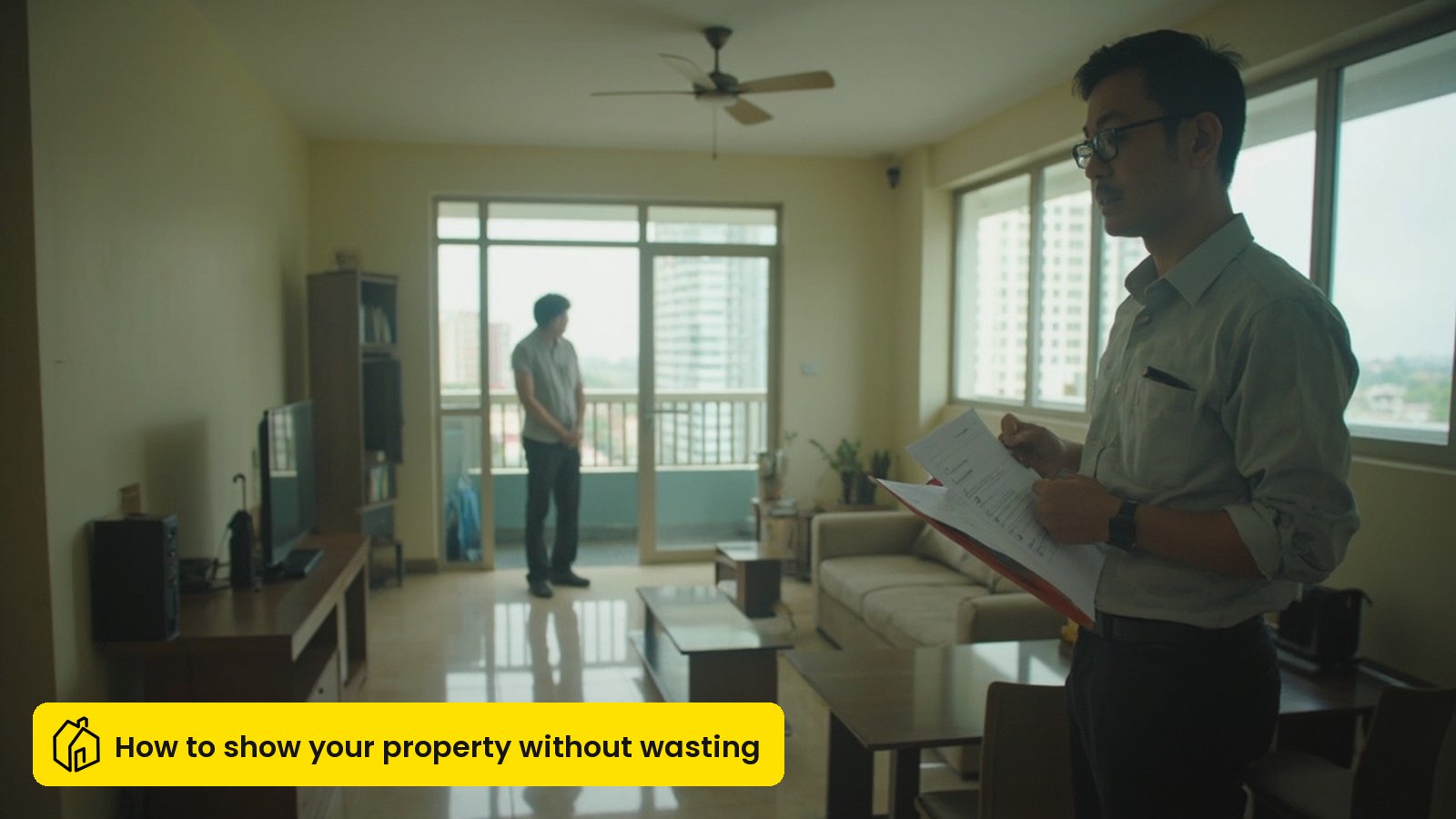
Why do property viewings waste a landlord's time?
**Most wasted viewings come from three causes: unscreened prospects who are not ready to commit, scheduling that creates clashes and no-shows, and a unit that is not presentation-ready. Fix all three before the first appointment and wasted trips drop sharply.
A viewing is the most consequential step in the rental process. It is the moment a prospect moves from curious to committed — or walks. Landlords who treat it as a passive open-door exercise accumulate no-shows, repeat visits from the same hesitant prospect, and a longer vacancy. The challenges are predictable: your schedule rarely aligns with every prospect's availability; some visitors have no real intention to rent; and a unit that looks neglected will cost more time in follow-up than the viewing itself.
What most Malaysia landlord guides miss: they tell you to "screen carefully" without giving the four exact questions, the exact scheduling discipline, or the disclosure pattern that prevents a viewing from turning into a complaint two months later. The rest of this page is the gap between generic advice and a viewing you can run in under an hour of your week.
How do you screen tenants before the viewing?
Run a short pre-screen before confirming any appointment. Ask about move-in timeline, budget, household size and whether the prospect has read the listing details. A prospect who cannot answer those four questions is not ready to view.
Pre-screening is not interrogation — it is a filter that protects everyone's time. A prospect with a vague move-in date ("maybe in two months") or a budget below asking rent is unlikely to convert. Confirming a viewing for them is work that produces no result. For a full breakdown of what to check before accepting a tenant, see the tenant screening guide.
| Pre-screen question | What a qualified answer looks like | Red flag |
|---|---|---|
| When do you need to move in? | Within 2–4 weeks, or a clear date | "Not sure yet" / "Just looking" |
| Is the asking rent within your budget? | Yes, or a range that overlaps | Asks you to drop below asking before visiting |
| How many people in the household? | Matches the unit's capacity | Vague or avoids the question |
| Have you read the full listing? | Yes, specific question about one detail | Has not read it; asks questions answered in the listing |
| Do you have tenancy documents ready? | IC, payslip or employment letter | Asks what documents are needed at the very last minute |
Keep the pre-screen to a short WhatsApp thread before you confirm a time slot. The point is not the length of the exchange — it is whether the prospect gives concrete answers. A "maybe" at this stage stays a "maybe" after a 45-minute visit.
How should you schedule viewings efficiently?
Batch viewings into two or three windows per week rather than accepting walk-ins on demand. Use a free scheduling link — Calendly or a shared calendar — so prospects self-select into available slots. This removes the back-and-forth and prevents double-bookings.
When the unit is vacant and there is genuine demand, multiple prospects will want to view at the same time. The scheduling problem is real: your working hours may not match a prospect's availability, and manual coordination across WhatsApp threads collapses into confusion. A scheduling tool does three things — it caps your commitment to defined windows, it shows prospects only the slots you have approved, and it sends automatic reminders that reduce no-shows. You can run it for free. The discipline is deciding your windows in advance and not accepting ad-hoc requests outside them.
If you are genuinely unable to attend viewings — because of work, travel, or managing multiple units — see the Homerunner section below. For the broader picture of running a rental without an agent, the guide on how to rent out property without an agent in Malaysia covers the full workflow from pricing to rent collection.
How do you prepare the unit for a viewing?
First impressions at a viewing are harder to recover from than first impressions online. Check every light, tap, lock and visible defect before the first appointment. A clean, working unit converts faster than a comparable unit with minor issues left unaddressed.
Walk through the property as a stranger would. Specific checks:
- Lights: replace any failed bulbs, especially in bathrooms and kitchens where poor light reads as damp or neglect.
- Water pressure and drainage: run every tap, flush every toilet, and flag any sink or shower drain that empties slowly — a slow drain reads as a hidden plumbing problem to a cautious tenant.
- Doors and windows: stiff locks or warped frames signal deferred maintenance.
- Cleanliness: wipe down surfaces, clear built-up grime from grout and window tracks, and remove any remaining personal items from a previous tenancy.
- Smell: open windows before the viewing, and address any source of persistent odour rather than masking it.
Minor defects that you plan to fix after signing should be disclosed, not hidden. A tenant who spots an issue you did not mention becomes suspicious of what else you may be concealing. The same disclosure principle sits at the heart of a valid tenancy under the law of contract — a misrepresentation that induces a tenant to sign can be challenged.
What should you cover during the walk-through?
Cover location advantages, property condition, modification rules and key tenancy terms in that order. Lead with what makes the unit worth renting; save contract terms for the end when the tenant is already interested.
The sequence matters. Opening with a list of restrictions before the tenant has formed any attachment produces pushback. Opening with the unit's genuine advantages — public transport, nearby amenities, building management quality, car park allocation — creates the context that makes the tenancy terms feel reasonable.
| Walk-through topic | What to say (and what to avoid) |
|---|---|
| Location and amenities | Name specific nearby transit stops, schools, or retail anchors. Avoid vague terms like "convenient area." |
| Condition and inventory | Walk through the inventory list on-site; note any items that will be repaired or replaced before move-in. |
| Modification rules | State what is permitted (minor picture hooks, for example) and what requires written permission. Be specific. |
| Tenancy terms | Cover rent amount, payment method, utilities responsibility, and move-out notice period. Do not compress this into one sentence. |
Keep the walk-through tight. A standard apartment does not need a one-hour tour — most of the useful information is in the first 25 minutes, and the last stretch is when prospects start composing their polite exit. If a prospect is clearly not going to convert, do not stretch the viewing to fill the slot; thank them and move on.
What does a Malaysia-safe viewing actually look like?
Treat every viewing as both a sales visit and a safety check: verify the prospect's identity, never collect a holding deposit on the spot, and never let an unverified stranger into a vacant unit alone.
This is the part most generic "how to show a rental" guides skip entirely, and it is where Malaysia-specific scams have hurt landlords in recent years.
| Safety step | What to do | What not to do |
|---|---|---|
| Prospect identity | Ask to see the IC/passport at the door; record the name on your visitor list | Do not let someone in whose name you do not have on file |
| Holding deposit at the viewing | Do not collect any deposit at the viewing itself | Do not accept cash, bank transfer, or "deposit to hold" promises from a stranger on the spot |
| Vacant-unit access | Stay with the prospect at all times in a vacant unit; lock up after | Do not hand over keys, access cards, or gate remotes for a "second look" by an unverified prospect |
| Solo landlord | Bring a partner or family member if you must show alone; share your schedule with someone you trust | Do not show alone at night to an unverified prospect |
| Listing impersonation | Tell prospects the listing URL on SPEEDHOME and ask them to apply through it, not via a side WhatsApp | Do not negotiate off-platform without verifying the listing is still live |
SPEEDHOME's Trust & Safety data records zero reported rental scams on the platform since April 2026 — every listing and landlord is verified before it goes live. That is the practical value of running your viewing through a verified platform: the prospect knows the listing is real, and you know the conversation is on the record.
Can SPEEDHOME Homerunners handle viewings for you?
The platform's Homerunner service is available to landlords who list on the platform in Kuala Lumpur and Selangor, and is included with the listing. A trained Homerunner handles the on-site or virtual viewing on your behalf, so you do not have to clear your schedule around prospect availability.
Homerunners are a practical option if you are overseas, working full-time hours, or managing more than one unit. Rather than coordinating every appointment personally, you list the property on SPEEDHOME and a Homerunner handles:
- On-site viewings — attending in person, presenting the unit, and answering prospect questions without requiring your presence.
- Live virtual viewings — conducting a video walk-through for tenants who cannot visit in person, particularly useful for out-of-state or overseas prospects.
- No-show and late-arrival management — absorbing the friction of unreliable prospects so it does not fall back on you.
The service is currently available for listed properties in Kuala Lumpur and Selangor. For properties outside those states, or if you prefer to manage viewings personally, the scheduling and pre-screening steps above still apply.
| Channel | Best for | What it cannot do |
|---|---|---|
| On-site viewing (you attend) | Local prospects you can vet on the day | Scale beyond one or two units without a Homerunner |
| Live virtual viewing (you attend) | Out-of-state tenants, overseas tenants, working full-time | Replace the prospect's physical inspection of water pressure, smell, neighbours |
| Live virtual viewing (Homerunner) | Scale across multiple prospects in different time zones | Replace a tenancy application — it only moves the prospect to "ready to apply" |
| Static photo / video tour | Filtering at the top of the funnel | Replace a live viewing for serious prospects — they will still ask for one |
| Homerunner on-site | Overseas landlord, multiple units, professional handover | Match your local knowledge of the building's quirks — share your notes before the slot |
See SPEEDHOME landlord services for the full overview of what is included when you list.
What if a tenant shows interest but delays signing?
Treat "interested" as time-bound. Set a soft deadline, and if the prospect wants to lock the unit, formalise interest with a short Memorandum of Understanding (MOU) plus a refundable holding deposit — not a verbal promise.
The default failure mode at this stage is the open-ended hold. The prospect says "I'm interested, give me a week," and the landlord keeps the unit off the market for someone who never converts. The fix has two parts:
| Step | What to do | What it covers |
|---|---|---|
| Soft deadline | Confirm in writing that the unit will remain available until a stated date, after which you will continue showing to other prospects | Prevents the indefinite hold without breaking rapport |
| MOU | A short written agreement that names the prospect, the unit, the asking rent, the move-in date, and the holding deposit amount | Converts verbal interest into something both sides can rely on |
| Refundable holding deposit | Typically one month's rent, held in escrow or by you, refundable if the tenancy does not proceed for reasons outside the tenant's control (e.g. your counterparty falls through) | Locks the prospect's commitment; the refund clause is what makes the deposit legally a deposit, not a penalty |
| Stamp and sign the TA the moment both sides commit | The full tenancy agreement should follow quickly, with stamp duty paid via e-Duti Setem on MyTax within 30 days of execution | The MOU is a bridge; the stamped TA is the binding instrument |
Never collect a holding deposit at the viewing itself — that is the red flag pattern in Malaysia rental scams. If the prospect is genuinely ready, they can wait the additional day or two it takes to send an MOU and arrange a bank transfer with a clear reference.
How do you use feedback after viewings to improve your conversion?
Ask each viewer one concrete question: what, if anything, made you hesitate? Hesitation is information. A pattern across multiple viewers — price, a specific defect, the access card arrangement — points to something you can fix before the next wave of viewings.
Feedback does not need to be formal. A short follow-up WhatsApp message ("Was there anything that put you off? Happy to clarify or fix it before we proceed") often surfaces an objection that would otherwise have silently ended the conversation. Positive feedback is useful too — it confirms which parts of your presentation are working and whether your asking rent is positioned correctly relative to what viewers say about comparable units they have seen.
SPEEDHOME is one option worth comparing alongside the routes above.
FAQ
How long should a property viewing take?
For a standard 1- to 3-bedroom apartment, 25 to 35 minutes is enough to walk through every room, discuss inventory, and answer questions — most of the useful signal is in the first half of that window. SPEEDHOME's Homerunner playbook for the platform's KL and Selangor listings sits in the same range. Longer viewings do not produce better-informed tenants — they usually signal that the landlord is over-explaining or that the prospect is not serious.
What documents should a landlord bring to a viewing?
Bring a printed or digital copy of the inventory list, a draft of the key tenancy terms (rent, deposit or Zero Deposit terms, notice period, utilities responsibility), and the building's house rules if applicable. Having these on hand shortens the gap between interest and signing. SPEEDHOME-prepared tenancy agreements include these clauses by default and can be sent to the prospect digitally after the viewing.
Is a virtual viewing as effective as an in-person one?
For tenants who are relocating from another state or overseas, a well-conducted live virtual viewing — where you walk the camera through every room, open every storage space, and answer questions in real time — can be sufficient to reach a decision. A static photo tour is not the same thing and rarely replaces a live view for serious prospects. SPEEDHOME's Homerunner service conducts live virtual viewings on behalf of landlords who list on the platform.
What if a tenant shows interest but delays signing?
Set a soft deadline: confirm in writing that the unit will remain available until a stated date, after which you will continue showing to other prospects. For genuine interest, formalise it with an MOU and a refundable holding deposit — typically one month's rent, refundable if the tenancy does not proceed for reasons outside the tenant's control. The full tenancy agreement and stamp duty via e-Duti Setem on MyTax should follow within days, not weeks.
Tenancy-agreement stamping — 2026 snapshot (figures current as of 2026-10):
| Item | 2026 rule / status |
|---|---|
| Stamp duty scale | RM1 / RM3 / RM5 / RM7 per RM250 (or part) of average annual rent, by duration band (Stamp Act 1949 First Schedule Item 49, as amended by Finance Act 2024) |
| Stamping window | Within 30 days of execution, via LHDN e-Duti Setem on MyTax |
| Former RM2,400 exemption | Removed from 1 January 2025 |
What is the biggest reason viewings fail to convert?
Unqualified prospects account for the majority of viewings that do not convert. A prospect who is still months from needing to move, or whose budget does not match the asking rent, will not sign regardless of how well the unit shows. Pre-screening before the appointment is more effective than improving the walk-through after the fact.
Accuracy note. This page is built on verified primary sources and a dated fact registry; figures are re-verified on each update. Spotted an error? Email [email protected] with this page's link.